
Scale control · Zero discharge
Water Conditioners
Salt-free, zero-discharge scale control that stops limescale forming on heated surfaces while leaving the natural mineral content of the water intact.
A conditioner solves a different problem from a softener, and the distinction matters commercially. A softener takes hardness out of the water. A conditioner leaves the minerals in place but changes their behaviour, so they no longer bond to the surfaces you are trying to protect.
AQUASTAG conditioning media works by nucleation. As water passes across the media surface, dissolved calcium and bicarbonate are converted into microscopic, electrically neutral crystals that stay suspended in the flow. Scale still forms — but it forms in the water column rather than on your heat exchanger, and it is carried harmlessly out with the flow. Existing deposits are gradually undercut and released over the following weeks.
Because nothing is exchanged, there is nothing to regenerate. No salt, no brine tank, no backwash line, no waste stream to discharge, and in most installations no power connection. For clients under a zero-liquid-discharge obligation, or sites where a drain simply is not available, that is often the deciding factor.
Applications
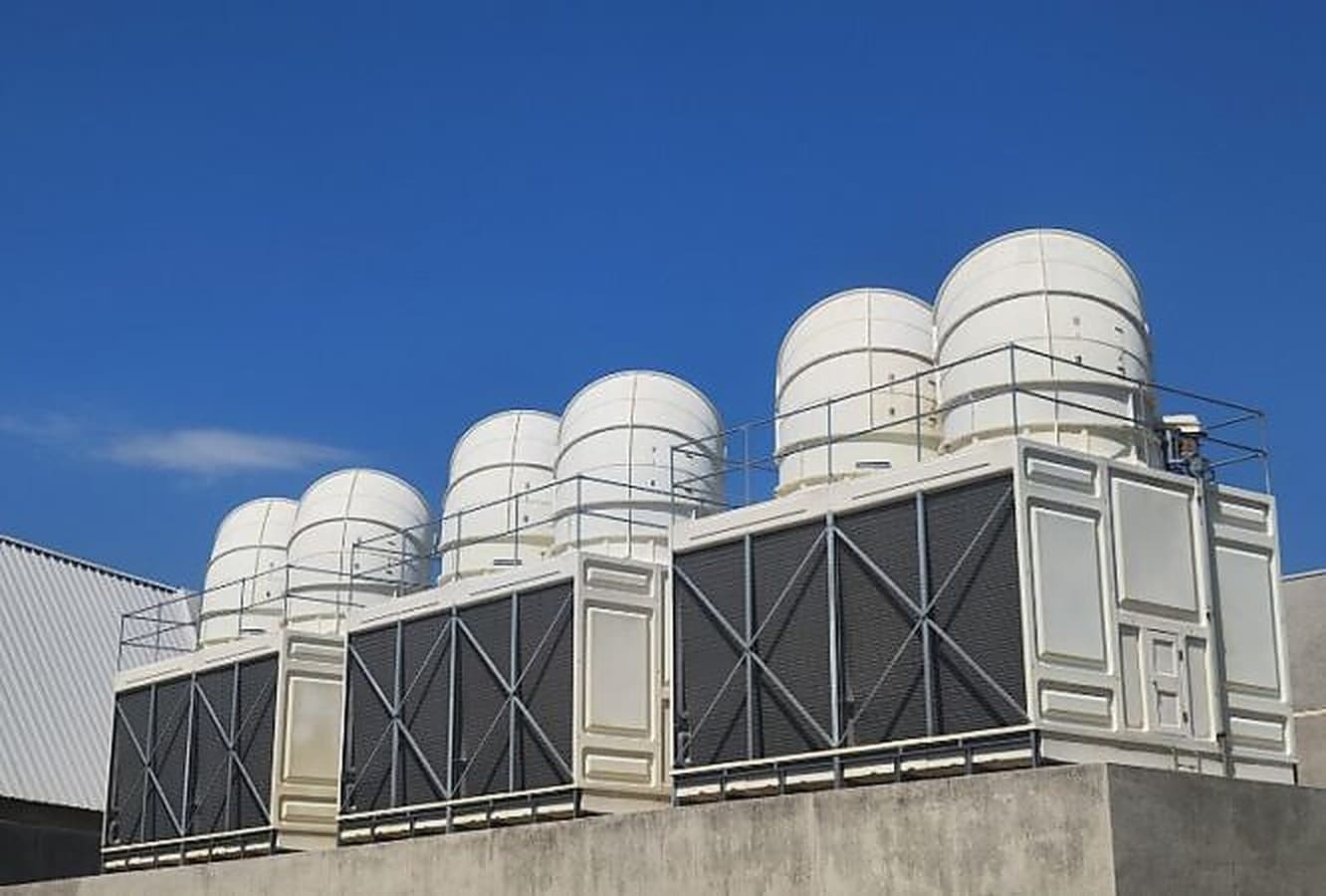
- Cooling towers and chiller circuits
- Plate and shell-and-tube heat exchangers
- Hotel and hospital hot water systems
- Villas, apartments and gated communities
- Zero-liquid-discharge industrial sites
How it works
The process, stage by stage
Move your cursor across this section — the surface responds like water.
Contact
Water passes through a vessel packed with catalytic conditioning media. No chemical is added and nothing is removed from the water.
Nucleation
Active sites on the media convert dissolved hardness into stable, sub-micron calcium carbonate crystals — the mineral changes phase rather than concentration.
Suspension
Those crystals stay suspended in the bulk flow. Having already crystallised, they have no tendency to adhere to pipe walls or heated surfaces.
Descaling
Conditioned water is slightly aggressive toward existing scale, so legacy deposits are progressively lifted and flushed away over several weeks of operation.
Engineering detail
What you get with an AQUASTAG conditioners system
No salt, ever
No brine tank, no bags of salt to store or handle, and no recurring consumable line in the operating budget.
Zero wastewater
Nothing is sent to drain — no backwash, no regeneration effluent. Suitable for zero-liquid-discharge sites and locations with no drain access.
Minerals retained
Calcium and magnesium stay in the water. Unlike softening, no sodium is added, so the supply remains suitable for drinking-water circuits.
Near-zero maintenance
No valves cycling, no controller to program and no moving parts in the flow path. Media is inspected periodically rather than serviced constantly.
Compact footprint
A single in-line vessel replaces the vessel-plus-brine-tank footprint a softener needs — valuable in plant rooms and basements.
Protects legacy pipework
Existing scale is gradually released, restoring bore diameter and heat transfer in systems that have been running hard for years.
Specifications
Technical data
| Capacity range | Domestic point-of-entry to industrial main-line duty |
|---|---|
| Operating principle | Catalytic nucleation / template-assisted crystallisation |
| Salt consumption | None |
| Wastewater generated | None — zero discharge |
| Power requirement | None in standard configurations |
| Effect on TDS | Unchanged — minerals are retained, not removed |
| Effect on hardness reading | Unchanged by design; scale adhesion is what is prevented |
| Media life | Multi-year, subject to feed water quality |
Ranges shown are indicative. Final specification is confirmed against your water analysis and duty requirement.
Where it is used
Typical applications
- Cooling towers and chiller circuits
- Plate and shell-and-tube heat exchangers
- Hotel and hospital hot water systems
- Villas, apartments and gated communities
- Zero-liquid-discharge industrial sites
- Commercial kitchens and dishwashers
- Solar water heating systems
- Sites with no drain connection available
Questions
Conditioners — frequently asked
Straight answers, including where this system is not the right choice.
Will a water conditioner reduce my hardness test reading?
No, and any supplier who claims otherwise is misrepresenting the technology. A conditioner does not remove calcium or magnesium, so a titration test will read much the same before and after. What changes is behaviour: the hardness is converted to a crystalline form that no longer bonds to surfaces. If your requirement is a low hardness number — for a boiler specification, for instance — you need a softener, and we will tell you so.
Conditioner or softener — which should I choose?
Choose a softener when a specification demands measurably low hardness: boiler feed, RO pre-treatment, dyeing, commercial laundry. Choose a conditioner when the objective is protecting equipment from scale with no salt handling, no waste stream and minimal maintenance — cooling circuits, hot water systems, domestic plumbing. We recommend based on your water report and duty, not on what carries a larger invoice.
Does it need electricity or plumbing changes?
Standard configurations need no power supply. Installation is in-line on the incoming main, and for most buildings it is a straightforward plumbing tie-in with isolation valves and a bypass so the system can be serviced without interrupting supply.
How long before existing scale clears?
Conditioned water works on legacy deposits gradually. Improvement in flow and heat transfer is typically noticed over several weeks, with the rate depending on how heavy the existing scale is and how much water passes through the system.
Client feedback
What our clients say
Water treatment is bought on trust, because most of what it does is invisible. These are the outcomes our clients describe.
Our borewell was running at 1,150 ppm and the previous plant could not hold output through a full shift. AQUASTAG re-did the pre-treatment before touching the membranes, which nobody else had suggested. Two years on, the permeate is still under 40 ppm and we have not replaced a single element.
We had scale building up in the boiler within weeks of every descaling. They tested the water, showed us the hardness figures and sized the softener against our actual steam load rather than quoting a standard model. Salt consumption came in almost exactly where they said it would.
Every bathroom in the block had yellow-brown staining and the residents were convinced it was the plumbing. AQUASTAG identified dissolved iron in the borewell and installed an iron removal filter ahead of the softener. The staining stopped completely within a fortnight.
Related
You may also need
Hardness removal · Ion exchange
Water Softeners
Ion-exchange softening plants that strip calcium and magnesium out of hard borewell and municipal water, protecting boilers, chillers, laundries and every heated surface downstream.
Reverse osmosis · 250 – 10,000+ LPH
Industrial & Commercial RO Plants
Turnkey reverse osmosis plants from 250 LPH to 10,000+ LPH — engineered pre-treatment, correctly staged membrane arrays and controls built for continuous industrial duty.
Point of use · RO + UV + UF
Domestic RO Purifiers
Multi-stage RO, UV and UF purifiers for homes and offices — specified against your actual tap water rather than sold from a shelf.
Need a conditioners system sized properly?
Send us your water analysis or just describe the problem. An engineer responds within 24 working hours.