Hardness removal · Ion exchange
Water Softeners
Ion-exchange softening plants that strip calcium and magnesium out of hard borewell and municipal water, protecting boilers, chillers, laundries and every heated surface downstream.
Hardness is the most expensive water problem most facilities never measure. Across Telangana and much of peninsular India, borewell supplies routinely test between 300 and 800 mg/L as CaCO3. Every litre of that water carries dissolved calcium and magnesium that precipitates the moment it is heated or evaporated — plating heat exchangers, glazing boiler tubes, blocking spray nozzles and quietly pushing energy consumption up month after month.
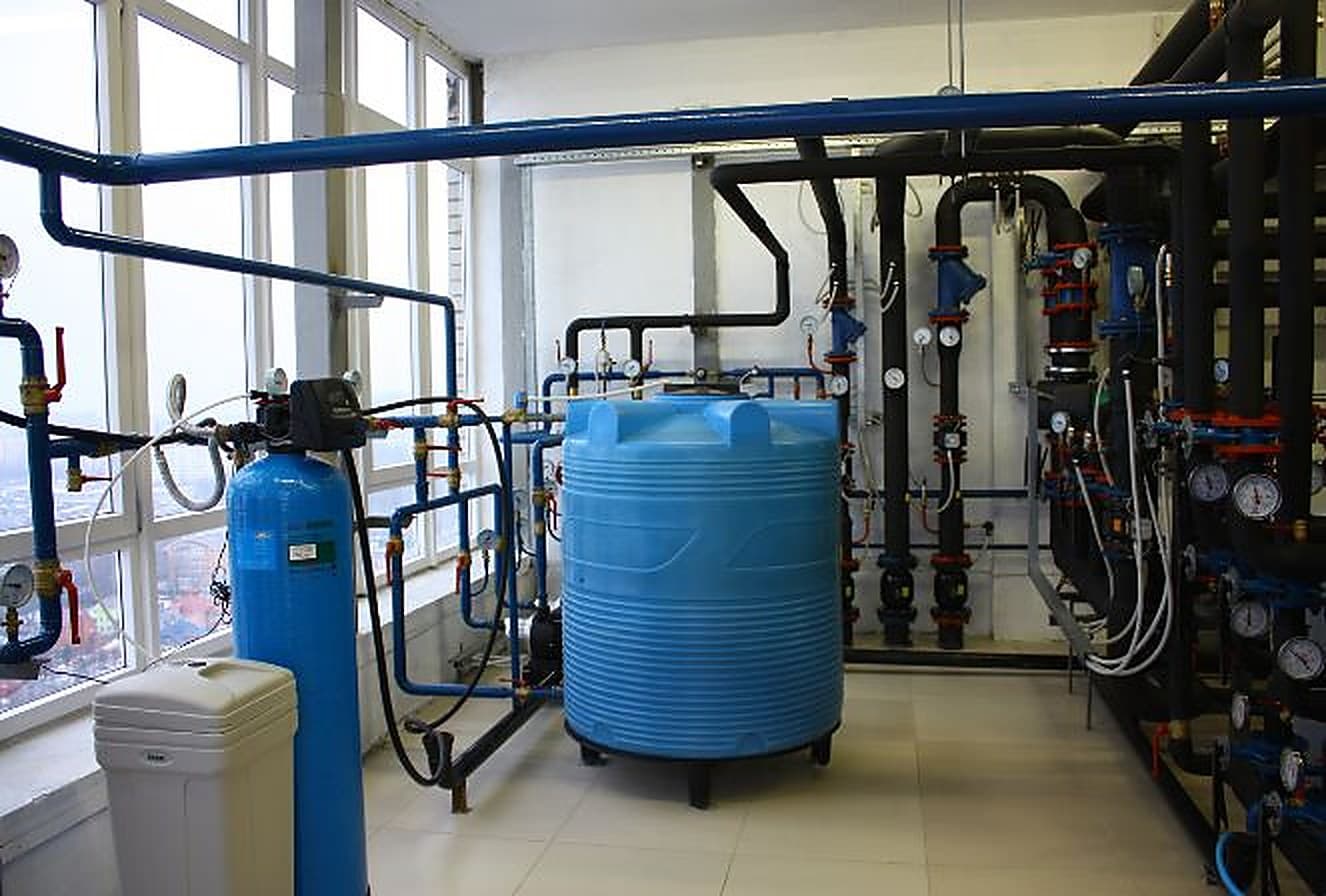
An AQUASTAG water softener removes that hardness at source. Raw water is passed through a bed of strong acid cation resin operating on the sodium cycle: calcium and magnesium ions are exchanged onto the resin, and sodium is released in their place. What leaves the vessel is water below 5 mg/L hardness — soft enough for boiler feed, cooling make-up, commercial laundry, dyeing, and as protective pre-treatment ahead of any reverse osmosis membrane.
We size every plant from an actual water analysis rather than a catalogue guess. Resin volume is calculated against your measured hardness, daily throughput and the output you need between regenerations, so the unit regenerates on a predictable cycle instead of exhausting halfway through a shift.
Applications
- Boiler feed water pre-treatment
- Cooling tower make-up water
- Commercial and hospital laundries
- Hotels, resorts and serviced apartments
- Textile dyeing and processing
How it works
The process, stage by stage
Move your cursor across this section — the surface responds like water.
Service run
Hard water flows down through the cation resin bed. Calcium and magnesium are exchanged for sodium and held on the resin. Soft water leaves at under 5 mg/L hardness.
Backwash
Flow is reversed to lift and reclassify the bed, flushing out suspended solids and any channelling that has formed during the service run.
Brine draw
A measured saturated sodium chloride solution is drawn through the bed. The concentration gradient reverses the exchange, stripping hardness back off the resin.
Rinse and refill
Residual brine is flushed to drain, the salt tank refills automatically, and the vessel returns to service. The whole cycle runs unattended on a meter or timer trigger.
Engineering detail
What you get with an AQUASTAG softeners system
Sized from your water, not a catalogue
Resin volume, vessel diameter and salt dosage are calculated from your measured hardness and daily demand, so the output between regenerations matches how you actually run.
Automatic multiport control
Meter-initiated or time-clock multiport valves regenerate without an operator. Metered control uses salt only when volume is actually consumed.
FRP or mild steel vessels
Corrosion-resistant FRP for standard duty; rubber-lined or epoxy-coated mild steel where pressure, temperature or site conditions demand it.
High-capacity exchange resin
Strong acid cation resin with a stable exchange capacity and a working life measured in years, not months, when correctly backwashed.
Duplex configuration available
Twin vessels alternate so one stays in service while the other regenerates — continuous soft water for processes that cannot stop.
Commissioned against a target
Handover includes a hardness test at the outlet and a signed AWEP checklist confirming the plant meets its design figure.
Specifications
Technical data
| Capacity range | 250 LPH to 100 m3/hr and above |
|---|---|
| Inlet hardness handled | Up to 1,500 mg/L as CaCO3 |
| Treated water hardness | Below 5 mg/L as CaCO3 |
| Vessel material | FRP, rubber-lined MS or epoxy-coated MS |
| Resin type | Strong acid cation, sodium cycle |
| Control | Manual, time-clock or meter-initiated multiport |
| Configuration | Simplex or duplex (continuous duty) |
| Regenerant | Sodium chloride (common salt) brine |
Ranges shown are indicative. Final specification is confirmed against your water analysis and duty requirement.
Where it is used
Typical applications
- Boiler feed water pre-treatment
- Cooling tower make-up water
- Commercial and hospital laundries
- Hotels, resorts and serviced apartments
- Textile dyeing and processing
- Pre-treatment ahead of RO plants
- Gated communities and housing societies
- Food processing and beverage lines
Questions
Softeners — frequently asked
Straight answers, including where this system is not the right choice.
What is the difference between a water softener and an RO plant?
A softener removes hardness — calcium and magnesium — by ion exchange, and leaves total dissolved solids essentially unchanged. An RO plant forces water through a semi-permeable membrane and removes the great majority of all dissolved salts, including hardness. Softened water protects equipment; RO water is what you treat when the requirement is potable or process-grade quality. In most industrial plants the two work together, with the softener protecting the RO membranes upstream.
How much salt will the softener consume?
Salt consumption is a direct function of your inlet hardness and the volume of water you treat, not of the vessel size. We calculate the figure during sizing and state it in the proposal, so the running cost is known before you order rather than discovered afterwards.
Is softened water safe to drink?
Softening exchanges calcium and magnesium for a small amount of sodium, so softened water is not intended as drinking water — particularly where a sodium-restricted diet applies. Where a facility needs both, we design a softened supply for equipment protection and a separate RO or purifier circuit for drinking points.
How often does a softener need regeneration?
That depends on hardness and throughput. A correctly sized plant is designed around a defined output between regenerations — commonly once every 24 hours for a commercial unit. Meter-initiated controls regenerate on actual volume consumed, which avoids wasting salt on low-usage days.
Do you supply water softeners outside Hyderabad?
Yes. We install across India and, as an IEC-registered exporter, supply equipment internationally. Site visits within Telangana are straightforward; for other locations we work from a water analysis report and site drawings, and depute commissioning engineers.
Client feedback
What our clients say
Water treatment is bought on trust, because most of what it does is invisible. These are the outcomes our clients describe.
Our borewell was running at 1,150 ppm and the previous plant could not hold output through a full shift. AQUASTAG re-did the pre-treatment before touching the membranes, which nobody else had suggested. Two years on, the permeate is still under 40 ppm and we have not replaced a single element.
We had scale building up in the boiler within weeks of every descaling. They tested the water, showed us the hardness figures and sized the softener against our actual steam load rather than quoting a standard model. Salt consumption came in almost exactly where they said it would.
Every bathroom in the block had yellow-brown staining and the residents were convinced it was the plumbing. AQUASTAG identified dissolved iron in the borewell and installed an iron removal filter ahead of the softener. The staining stopped completely within a fortnight.
Related
You may also need
Scale control · Zero discharge
Water Conditioners
Salt-free, zero-discharge scale control that stops limescale forming on heated surfaces while leaving the natural mineral content of the water intact.
Reverse osmosis · 250 – 10,000+ LPH
Industrial & Commercial RO Plants
Turnkey reverse osmosis plants from 250 LPH to 10,000+ LPH — engineered pre-treatment, correctly staged membrane arrays and controls built for continuous industrial duty.
Biological treatment · Water reuse
Sewage Treatment Plants (STP)
Compact biological sewage treatment plants that meet pollution control board discharge norms and turn wastewater into a reusable resource for flushing and landscaping.
Need a softeners system sized properly?
Send us your water analysis or just describe the problem. An engineer responds within 24 working hours.