
Consumables & dosing
Water treatment chemicals
Antiscalants, membrane cleaners, resin care, boiler and cooling programmes, STP and ETP chemistry, pool care and pH correction — supplied with a dosing schedule calculated from your water, not a generic label instruction.
Why it matters
The cheapest line on the invoice, protecting the most expensive asset
Chemicals are a small fraction of what a treatment plant costs to run, and they are the item most often bought on price alone. That is usually a false economy. An under-dosed or wrongly specified antiscalant does not announce itself — the plant keeps producing water while scale quietly builds on the membrane face, and the cost appears eighteen months later as a premature element replacement.
We supply chemicals the same way we specify equipment: against a water analysis and a defined duty. Every supply comes with a calculated dose rate, the technical and safety documentation, and a replenishment schedule worked out from your actual consumption.
We supply to plants we built and plants we did not. What we will not do is quote a chemical without knowing what it is going into.

A note on softener salt
We do not supply it. Salt is a bulk commodity you can source locally at a better price than we could sensibly offer. We supply the resin cleaning chemicals that actually extend resin life — which is where the saving genuinely is.
How we supply
Three things that come with every consignment
Move your cursor across this section — it behaves like the surface of water.
Specified against your water
Antiscalant is not one product. The grade that controls carbonate scaling will not control silica. We match the chemistry to your feed analysis and recovery, not to a catalogue page.
TDS and MSDS with every supply
Technical and Material Safety Data Sheets are issued with each consignment — a requirement rather than a courtesy for pharmaceutical, food and beverage clients under audit.
Scheduled replenishment
We calculate consumption from your plant capacity and dose rate, then supply against that schedule. Running dry mid-month is an expensive way to lose a set of membranes.
Supply scope
What we stock, by application
Seven categories covering the full treatment cycle — from protecting an RO membrane to balancing a swimming pool.
Membrane protection
RO Plant Chemicals
Membranes fail for three reasons: scale, oxidation and biofouling. Each has a different chemical answer, and using the wrong one — or the right one at the wrong dose — is how a three-year element ends up being replaced in twelve months.
- RO Antiscalant
- Holds calcium carbonate, calcium sulphate, barium, strontium and silica in solution as the reject stream concentrates.
- Dosed continuously ahead of the high-pressure pump, typically 3–6 ppm. The correct grade depends on your LSI and silica loading — a general-purpose antiscalant will not control silica.
- Sodium Metabisulphite (SMBS)
- Removes residual free chlorine before it reaches the membrane surface.
- Thin-film composite membranes oxidise irreversibly on chlorine exposure. Dosed after carbon filtration as a second barrier, roughly 3 ppm SMBS per 1 ppm free chlorine.
- Alkaline CIP Cleaner
- Clean-in-place cleaner for organic fouling, biofilm and silt.
- High-pH formulation for the fouling that carbon and cartridge filtration let through. Run first when both organic and scale fouling are present.
- Acidic CIP Cleaner
- Clean-in-place cleaner for carbonate scale and metal oxides.
- Low-pH formulation targeting calcium carbonate, iron and manganese deposits. Always follows the alkaline stage, never the reverse.
- Non-Oxidising Biocide (DBNPA)
- Controls bacterial growth without attacking the membrane.
- Shock-dosed on a defined interval. Oxidising biocides destroy TFC membranes, so chlorine and hypochlorite are never an option on the membrane side.
- Membrane Preservative
- Protects elements during shutdown or storage.
- Sodium bisulphite preservation solution for plants idle beyond 48 hours. Prevents the biological growth that ruins membranes during seasonal shutdowns.
Resin life extension
Softener & Resin Care
Ion exchange resin should last years. It usually does not, because iron, organics and biological growth accumulate on the bead surface and steadily reduce exchange capacity until the softener starts breaking through mid-cycle.
- Resin Iron Cleaner
- Strips accumulated iron and manganese fouling from cation resin.
- The single most common cause of premature softener failure on Indian borewell supplies. Restores capacity that would otherwise need a full resin changeout.
- Resin Organic Cleaner
- Removes organic and tannin fouling from the resin bed.
- Brine-compatible cleaner for surface water and high-organic feeds, where fouling blinds the bead rather than exhausting it.
- Resin Sanitiser
- Controls bacterial growth within the resin bed.
- For softeners on intermittent duty, where standing water in the vessel between regenerations allows biological growth to establish.
- Replacement Cation Resin
- Food-grade strong acid cation resin, sodium cycle.
- Supplied where cleaning is no longer economic. We assess the existing bed first — replacing resin that only needed cleaning is an expensive mistake.
- Filter Media
- Replacement graded sand, gravel, anthracite and activated carbon.
- Media for multigrade and carbon filters, supplied to the grading your vessel was designed around rather than whatever is on the shelf.
Steam side protection
Boiler Water Chemicals
Boiler chemistry protects an expensive pressure vessel from two things at once: scale that insulates the heat transfer surface and drives fuel consumption up, and dissolved oxygen that pits the tubes from the inside.
- Oxygen Scavenger
- Removes dissolved oxygen from the feed water.
- DEHA or catalysed sodium sulphite depending on operating pressure and whether the steam contacts a food product. Dosed to the feed tank, not the boiler.
- Boiler Scale Inhibitor
- Prevents hardness scaling on tubes and the heat transfer surface.
- Phosphate or polymer-based internal treatment that conditions residual hardness into a mobile sludge which blows down rather than adhering.
- Alkalinity Builder
- Maintains boiler water pH within the specified band.
- Holds pH in range to keep the protective magnetite layer stable — the film that actually prevents corrosion.
- Condensate Line Treatment
- Protects return lines from carbonic acid corrosion.
- Neutralising amine that carries with the steam and raises condensate pH, protecting the return system that a feed-side programme cannot reach.
- Sludge Conditioner
- Keeps precipitated solids dispersed for effective blowdown.
- Prevents settled sludge baking onto the boiler shell, and keeps blowdown actually removing solids rather than just water.
Open recirculating systems
Cooling Tower Chemicals
A cooling tower concentrates everything in the make-up water while running warm and fully aerated — ideal conditions for scale, corrosion and microbiological growth simultaneously. All three need managing together.
- Scale & Corrosion Inhibitor
- Combined programme for both failure modes in one dose.
- Phosphonate and polymer blend selected against your make-up water chemistry and the cycles of concentration you actually run.
- Oxidising Biocide
- Routine microbiological control.
- Stabilised bromine or chlorine donor for continuous control of general bacterial load in the recirculating water.
- Non-Oxidising Biocide
- Alternated shock dose to prevent resistance.
- Isothiazolinone or quaternary formulations, rotated with the oxidising programme so the population cannot adapt to a single chemistry.
- Biodispersant
- Breaks up established biofilm so biocide can reach it.
- Biofilm shields the organisms underneath. Without a dispersant, biocide only kills the surface layer and the colony re-establishes within days.
- Descalant
- Offline chemical descaling of fill, condensers and heat exchangers.
- Inhibited acid cleaning for systems already scaled, restoring heat transfer before a preventive programme is started.
Wastewater treatment
STP & ETP Chemicals
Effluent and sewage plants need chemistry at both ends — physical–chemical treatment to drop out solids and correct pH, and biological support to keep the microbial population healthy enough to do the actual work.
- Poly Aluminium Chloride (PAC)
- Primary coagulant for suspended solids and turbidity.
- Effective across a wider pH band than alum and generates less sludge — the default coagulant for most Indian STP and ETP applications.
- Polyelectrolyte
- Flocculant that binds coagulated particles into settleable floc.
- Anionic, cationic or non-ionic grade selected by jar test against your actual effluent. Also used for sludge dewatering ahead of a filter press.
- Bio-Culture
- Bacterial consortium for biological treatment and bioaugmentation.
- Seeds a new plant at commissioning and recovers one that has been shocked by a toxic load or extended shutdown. The usual fix for a plant that has started to smell.
- Ferric Chloride / Alum
- Alternative coagulants, including phosphate removal duty.
- Ferric chloride where phosphate has to be precipitated to meet a discharge consent; alum where cost matters more than sludge volume.
- Defoamer
- Controls foaming in aeration tanks and equalisation.
- Silicone or non-silicone antifoam for surfactant-heavy influent, where foam otherwise carries over and disrupts the aeration basin.
- Odour Control
- Neutralises hydrogen sulphide and organic odour compounds.
- For plants sited close to occupied buildings. Chemistry is a supplement to correct aeration, never a substitute for it.
Pool & water body care
Swimming Pool Chemicals
Pool water is a balancing exercise between disinfection, pH and hardness. Get the balance wrong and you either irritate swimmers or quietly corrode the plant and the pool surface itself.
- TCCA Chlorine Tablets (90%)
- Stabilised chlorine for sustained disinfection.
- 200g or 20g trichloroisocyanuric acid tablets. Stabilised against UV loss, which matters for outdoor pools in Indian sunlight.
- Stabilised Chlorine Granules
- Fast-acting disinfection and shock dosing.
- SDIC granules for rapid correction after heavy bather load or a contamination event.
- pH Plus / pH Minus
- Raises or lowers pool water pH into the operating band.
- Soda ash to raise, sodium bisulphate to lower. Outside pH 7.2–7.6 chlorine loses effectiveness regardless of how much you dose.
- Alkalinity Increaser
- Stabilises pH against swings.
- Sodium bicarbonate to build total alkalinity, which is what stops pH drifting after every correction.
- Algaecide
- Prevents and clears algal growth.
- Quaternary or copper-based, dosed preventively. Far cheaper than shock-treating a pool that has already turned green.
- Pool Clarifier
- Coagulates fine particles so the filter can capture them.
- Clears the persistent haze caused by particles too fine for the sand filter to remove unaided.
- Test Kits & Reagents
- DPD and phenol red reagents for routine testing.
- Dosing without testing is guesswork. Supplied with the programme so the operator can actually verify what they are doing.
General purpose
Disinfection & pH Correction
The common bulk chemicals that almost every treatment plant needs at some point — for disinfection, for correcting pH before or after treatment, and for restoring mineral balance to over-purified water.
- Sodium Hypochlorite
- Liquid chlorine for disinfection and pre-oxidation.
- Supplied at standard commercial strength for STP final disinfection, tank sanitisation and pre-oxidation ahead of iron removal.
- pH Booster / Alkali Dosing
- Raises pH of treated or permeate water.
- Caustic soda or soda ash solution. RO permeate is mildly acidic and aggressive to distribution pipework — correcting pH protects the network downstream.
- pH Reducer
- Lowers pH where feed alkalinity is excessive.
- Hydrochloric or sulphuric acid dosing, used to bring feed water into the band a downstream process actually requires.
- Mineral / Remineralisation Cartridge
- Restores calcium and magnesium to RO permeate.
- Corrects the flat taste of unmineralised RO water and reduces its aggressiveness toward pipework and fittings.
- Bleaching Powder & Hydrated Lime
- Bulk disinfection and alkalinity correction.
- Supplied for community water schemes, construction sites and applications where bulk cost governs the choice.
Dosing equipment
A correct chemical, delivered inaccurately, is still a wasted chemical
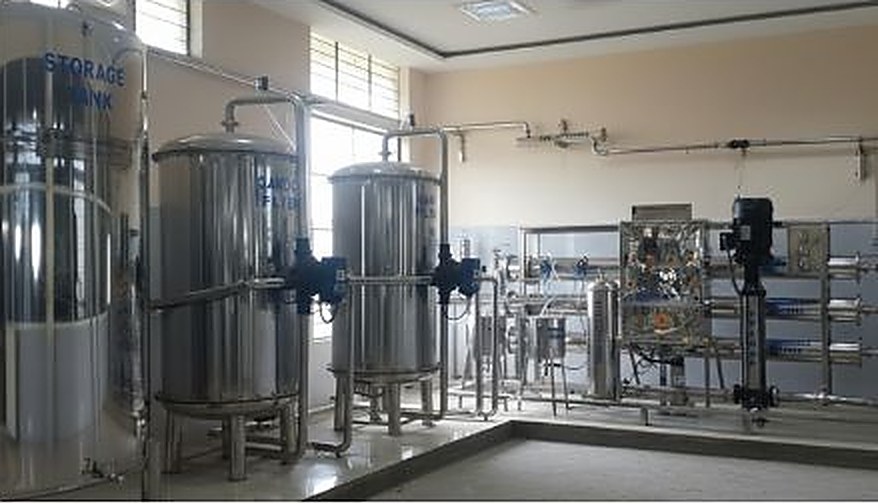
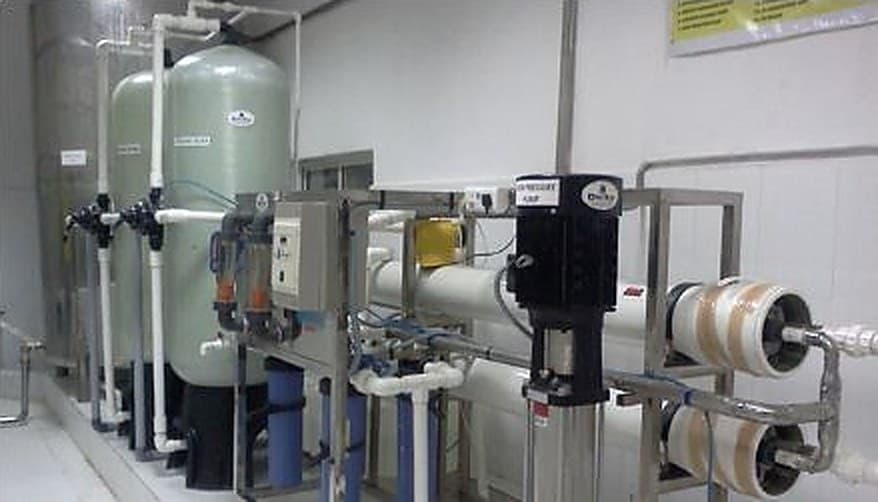
We supply and commission the dosing hardware alongside the chemistry — electronic dosing pumps, calibrated tanks, injection assemblies, tubing and level protection.
Questions
Chemicals — frequently asked
Including what we deliberately do not sell.
Do you supply chemicals for plants you did not install?
Yes. We supply to any plant, but we will ask what the system is and what the feed water looks like before quoting. Antiscalant in particular is not a single product — the grade that controls carbonate scaling will not control silica, and dosing the wrong one simply wastes money while the membranes keep fouling.
How do I know what dose rate to use?
It is calculated, not guessed. Dose rate depends on your feed water analysis, recovery and operating conditions. We provide a dosing schedule with the supply, and where a plant is under our AMC we verify the dose is actually being achieved at each service visit rather than assuming it.
Do you supply softener salt?
No. Salt is a bulk commodity that is usually cheaper sourced locally, and we would rather not mark up something you can buy well without us. We do supply the resin cleaning chemicals that actually extend resin life, which is where the money is genuinely saved.
Are technical and safety data sheets provided?
Yes. Technical Data Sheets and Material Safety Data Sheets are supplied with every consignment. For clients under audit — pharmaceutical, food and beverage in particular — this documentation is a requirement, not a courtesy.
Can you set up a scheduled supply so we do not run out?
Yes. We work out your consumption rate from plant capacity and dose rate, then schedule replenishment against it. Running out of antiscalant mid-month and continuing to operate is one of the more expensive ways to lose a set of membranes.
Do you supply dosing pumps and tanks as well?
Yes. Electronic dosing pumps, calibrated dosing tanks, injection assemblies and the associated tubing — supplied and commissioned. There is no point in a correctly specified chemical if the dosing system delivering it is not accurate.
Need chemicals matched to your plant?
Send us your system details and feed water analysis. We will come back with the right grade, the calculated dose rate and a supply schedule.